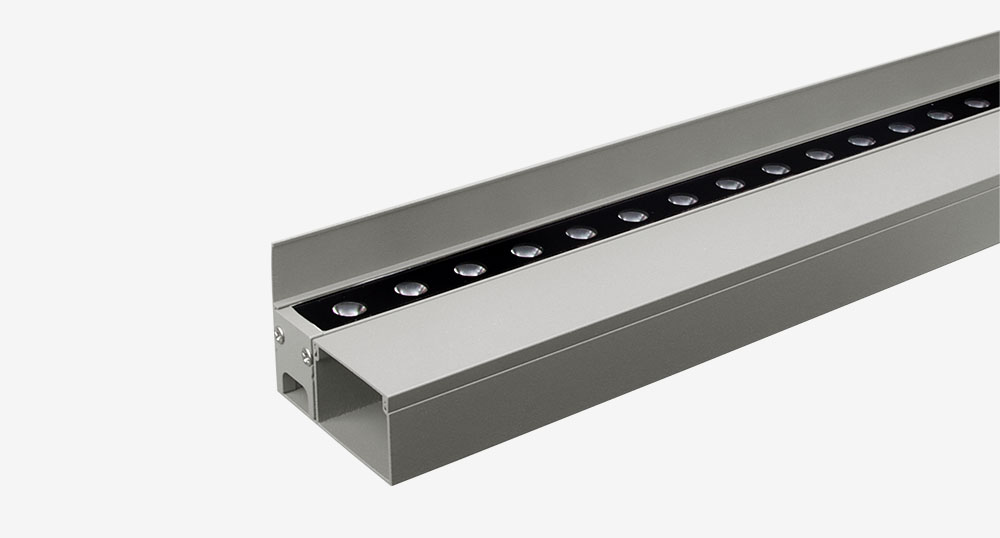


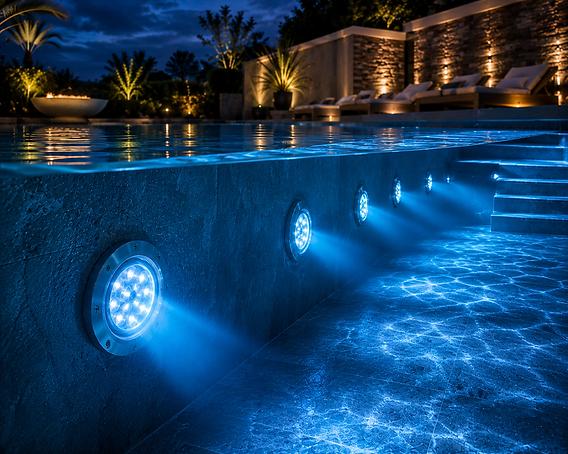
Underwater LED lighting plays an important role in swimming pools, musical fountains, landscape ponds, resort water features and waterfront developments. These applications require more than a waterproof outdoor luminaire. The selected fixture must be suitable for its immersion conditions, water chemistry, electrical installation, cable arrangement and maintenance requirements.
A product designed for occasional water exposure may not be suitable for continuous submersion. Likewise, a luminaire with an IP68 rating is not automatically suitable for every water depth, chemical environment or underwater installation.
For lighting designers, landscape architects, fountain system integrators, electrical contractors and procurement teams, a reliable specification should define the operating environment, applicable safety requirements, materials, control functions and installation details before products are ordered.
This guide explains how to specify underwater LED lighting for pools, fountains and ponds, with practical considerations for ingress protection, electrical safety, corrosion resistance, DMX control and commissioning.
Different water features create different operating conditions. The first step is to identify how the fixture will be installed and what it will experience during normal operation.
Pool lighting must be selected for the intended immersion conditions and the chemical environment created by the pool's treatment system. Water temperature, disinfectants, pH management, mounting arrangements and access for maintenance can all affect product suitability.
Electrical safety is especially important in areas where people enter the water. Specify a luminaire intended for the application and verify the electrical installation requirements for the project jurisdiction.
Fountain lighting may operate continuously underwater, near moving water jets or in areas exposed to repeated spray. Some systems also require synchronized RGB or RGBW effects.
The specification should address installation depth, water movement, mounting stability, cable routing, control compatibility and access to drivers or other serviceable components. Where high-pressure jets are present, confirm that the fixture and its mounting arrangement are suitable for the actual exposure.
Garden ponds and landscape water features may contain suspended sediment, algae, organic deposits and seasonal temperature variations. Some installations remain submerged throughout the year, while others are drained for maintenance or winter shutdown.
Specify the intended operating conditions, including normal water level, maximum depth, cleaning method and whether freezing or ice formation is possible.
Saltwater ponds, marina features and some coastal water installations create additional corrosion concerns. Material compatibility must be assessed for the water chemistry and exposure conditions rather than based solely on a product's appearance or a generic marine-grade claim.
For further guidance, see HIPO's coastal outdoor lighting corrosion resistance and material guide, if this page is available on the site.
Ingress protection is an important part of underwater luminaire selection, but the rating must be interpreted in the context of the intended installation.
IP67 and IP68 are not interchangeable labels. More importantly, an IP rating alone does not establish that a luminaire is suitable for every underwater application.
Before specifying a submersible LED light, document:
Normal operating water depth and maximum possible depth.
Whether the fixture is continuously submerged or exposed to intermittent immersion.
Expected water pressure and any unusual hydraulic conditions.
Water temperature and relevant chemical exposure.
Cable-entry and connection arrangements.
The required product certification or test documentation.
For an IP68 product, ask the supplier to identify the conditions associated with the manufacturer's declared rating and the relevant test evidence. Do not assume that all IP68 products have the same allowable depth or immersion conditions.
A fixture evaluated under one set of conditions should not automatically be assumed suitable for a deeper installation.
Ingress protection addresses defined enclosure-protection conditions. It does not, by itself, establish electrical safety for a swimming pool, resistance to every water treatment chemical, suitability for a particular mounting arrangement or compatibility with a dynamic fountain system.
For pool and similar applications, IEC 60598-2-18:2022 specifies particular requirements for fixed luminaires intended for use in or in contact with water. Electrical installation requirements must also be reviewed separately. North American projects may require compliance with applicable product standards, including UL 676 where relevant.
The project team should confirm the current applicable edition, local adoption and product certification requirements before procurement.
For a broader explanation of enclosure protection and project-based selection, see HIPO's IP & IK ratings for outdoor lighting guide.
Underwater lighting requires a coordinated electrical design. Voltage, isolation, protective devices, cable construction and installation arrangements should be selected according to the applicable electrical code and the luminaire's certification.
Low-voltage underwater lighting is used in many applications, but there is no single voltage that should be prescribed for every pool, fountain and pond.
The appropriate supply may depend on the project jurisdiction, luminaire design, installation location, required safety measures, cable length, power demand and control system. A 12 V AC pool luminaire and a 24 V DC fountain luminaire, for example, may belong to different product and system configurations.
The project specification should state the required operating voltage and supply characteristics based on the approved design. Do not connect a luminaire to a different supply simply because the voltage appears compatible.
The electrical designer should determine the required supply isolation, residual-current protection, grounding or bonding arrangements and other protective measures in accordance with the applicable rules.
For installations in the United States, relevant provisions may include NEC Article 680. For other markets, the corresponding national or regional requirements should be reviewed.
The exact protective arrangement depends on the installation type and local code. It should be designed and verified by a qualified electrical professional rather than inferred from the luminaire's IP rating.
Cable joints, connectors, junction boxes and power supplies must be selected for their actual installation location. A component suitable for a dry equipment room is not automatically suitable for continuous submersion.
Before ordering, verify:
Whether the luminaire includes a factory-attached cable.
The cable type, length and approved connection method.
Whether any connector or joint is rated for the intended immersion conditions.
Where power supplies, controllers and junction boxes are permitted to be installed.
Whether the cable route allows inspection and replacement without damaging the fixture.
Avoid cutting or extending a factory cable underwater unless the manufacturer explicitly permits the proposed method and the connection components are suitable for the application.
Water chemistry can influence the long-term performance of the housing, fasteners, lens, seals and cable components. A material that performs well in a freshwater pond may not be appropriate for a heated pool or a chloride-rich environment.
Grades such as 304 and 316L stainless steel are used in various lighting and water-feature applications. Their suitability depends on the actual exposure, fabrication, surface condition, component geometry and maintenance.
316L is often considered where chloride exposure is a concern, but it should not be described as universally corrosion-proof in pools or saltwater environments. The project team should assess the water chemistry and obtain material documentation for the specific product.
Where a product uses several metals, evaluate their compatibility at contact points and fasteners as well as the main housing.
Engineering plastics can be useful in underwater lighting because they do not corrode in the same way as metals. However, performance depends on the specific polymer grade, temperature, ultraviolet exposure, mechanical loading and compatibility with cleaning agents or water treatment chemicals.
Do not treat all PC, PBT or other polymer components as equivalent. Request the relevant material specification when the application has demanding chemical or mechanical requirements.
Seals and cable-entry components are critical to the complete enclosure. Material choice should be based on compatibility with the water chemistry, temperature, compression requirements and intended service conditions.
EPDM, silicone and fluorosilicone may be used in different sealing applications, but no single gasket material is automatically suitable for every underwater luminaire.
When evaluating a product, ask the manufacturer to clarify the sealing design, approved installation method, serviceability and any restrictions on field repair.
The lens must be suitable for the expected mechanical exposure, cleaning procedures, temperature variation and installation orientation. For upward-facing fixtures installed in pool floors or fountain basins, the project should also consider potential impact and access conditions.
Optical performance matters as much as material selection. Beam distribution, color consistency, glare control and the aiming position should be selected according to the water feature's design and the intended visual effect.
The control system should match the visual requirements of the project and the capabilities of the selected luminaire.
| Lighting requirement | Typical approach | Key checks |
|---|---|---|
| Fixed white illumination | Single-color or fixed-white fixture | Color temperature, output, beam distribution and switching method |
| Simple color selection | RGB or RGBW fixture with compatible controller | Available colors, channel configuration and controller compatibility |
| Synchronized fountain effects | DMX-compatible RGB/RGBW fixtures and a suitable control system | Addressing, channel count, signal distribution, programming and commissioning |
| Large water feature with multiple zones | Coordinated fixture groups and control architecture | Cable routes, grouping, fault isolation, access and future expansion |
DMX512 can be suitable for fountain projects requiring programmed color changes, transitions, synchronized scenes or coordinated effects across multiple fixtures.
However, DMX compatibility does not mean that fixtures will synchronize automatically. The system requires compatible hardware, suitable signal wiring, addressing and controller programming.
For a musical fountain, coordinate the lighting control system with the fountain controller and show-control workflow. Timing and synchronization requirements should be defined during design, not left until installation.
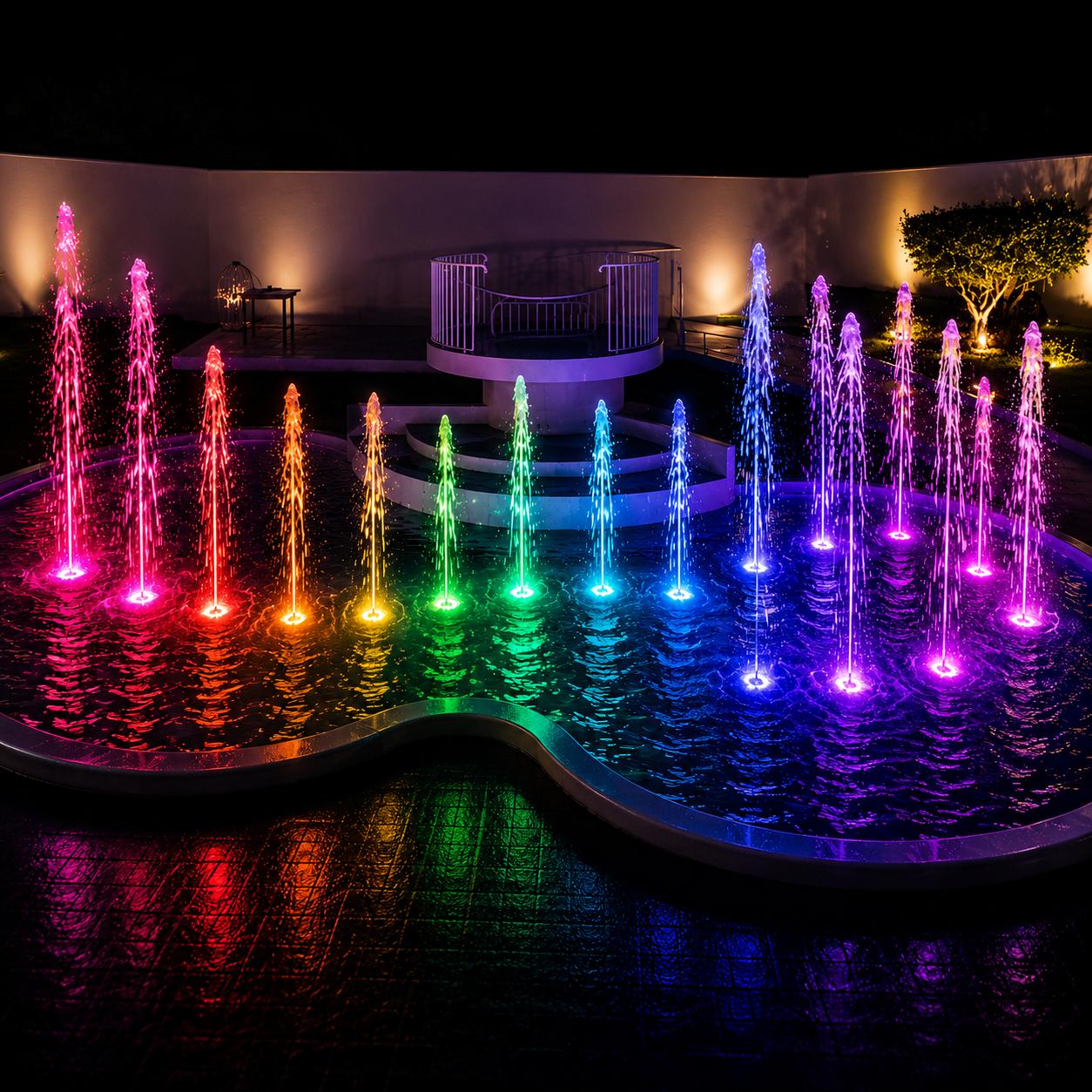
A DMX-controlled underwater lighting system may include luminaires, power supplies or drivers, DMX controllers, signal distribution components and associated wiring. Confirm compatibility across these components before purchase.
Ask the supplier to document the fixture's control protocol, input requirements, channel configuration, cable arrangement and any limitations on the number of fixtures or signal-line topology.
For more detail on control-system selection, see HIPO's DMX vs. DALI vs. 0–10V outdoor lighting control guide.
Correct installation is essential to preserving the luminaire's intended protection and performance. Even a suitable underwater fixture may be compromised by damaged cables, unapproved joints, incorrect mounting or incompatible cleaning procedures.
Review the approved product datasheet and installation instructions. Confirm the installation depth, mounting method, cable length, required accessories and any limitations on the operating environment.
Check that the fixture model and control configuration match the approved submittal. Inspect the housing, lens and factory cable for damage before installation.
Follow the manufacturer's instructions for mounting, cable routing and electrical connections. Do not pull, twist or bend the cable beyond its permitted limits.
Use only approved connection methods and components. If a cable extension or field joint is necessary, confirm the suitability of the proposed assembly for the intended underwater conditions before work proceeds.
Coordinate the fixture position with fountain nozzles, pool fittings, water circulation equipment and maintenance access. The installation should allow the fixture to be removed or serviced as intended.
Before handover, the project team should verify:
The installed model and supply arrangement match the approved design.
The fixture is mounted securely and at the specified depth.
Cable routing and connections comply with the approved installation details.
Electrical protective measures have been inspected and tested as required.
Static colors, dimming functions or DMX scenes operate as specified.
The final fixture locations and relevant electrical details are recorded in the as-built documents.
Electrical testing and commissioning should be performed by qualified personnel in accordance with the applicable requirements.
Maintenance frequency should reflect water chemistry, sediment, algae growth, operating hours, environmental exposure and manufacturer recommendations.
Periodic inspection may include checking the lens for deposits or damage, reviewing visible cable sections, confirming control operation and investigating any protective-device trips or repeated lighting faults.
Use cleaning products and methods approved for the specific luminaire materials. Avoid abrasive tools or chemicals that could damage the lens, seals or surface finish.
For installations in cold climates, confirm whether the fixture is designed to remain submerged during freezing conditions. If seasonal draining or removal is required, follow the manufacturer's instructions rather than assuming every underwater luminaire can withstand freeze-thaw exposure.
Use this checklist when preparing a tender, technical schedule or supplier evaluation.
| Item | Information to define or verify |
|---|---|
| Application | Swimming pool, musical fountain, freshwater pond, saltwater feature or marina installation |
| Immersion conditions | Normal depth, maximum depth, immersion pattern and relevant pressure conditions |
| Ingress protection | Declared rating and supporting documentation for the intended application |
| Product suitability | Applicable product standards, certification and installation restrictions |
| Electrical supply | Approved operating voltage, supply arrangement and compatible equipment |
| Electrical safety | Applicable isolation, protective devices, grounding or bonding and local code requirements |
| Housing and lens | Material specifications, mechanical suitability and environmental compatibility |
| Water chemistry | Relevant disinfectants, chloride exposure, pH conditions, cleaning agents and temperature |
| Cable and connections | Cable type, length, connection method and suitability for the intended immersion conditions |
| Control system | Fixed white, RGB, RGBW, DMX512 or another specified control method |
| Installation | Mounting arrangement, installation depth, cable routing and service access |
| Commissioning | Required electrical checks, functional tests, color tests and control verification |
| Documentation | Datasheet, installation manual, relevant test reports and product identification |
| Maintenance and warranty | Approved cleaning method, service procedure, warranty terms and replacement arrangements |
For large projects, the tender should distinguish mandatory safety and performance requirements from preferred product features. It should also identify which documents must be submitted with the quotation and which are required before delivery.
Not automatically. The required protection depends on the application and exposure conditions. For a luminaire intended for continuous submersion, confirm that the product's declared rating and supporting documentation cover the intended installation. Do not use an IP rating alone as proof of suitability for a pool or fountain.
No. The supply arrangement must match the selected luminaire, the approved electrical design and applicable local requirements. Specify the operating voltage and protective measures only after checking the product documentation and installation conditions.
No material should be described as universally corrosion-proof. Suitability depends on water chemistry, temperature, fabrication, surface condition, material grade and maintenance. Verify the material specification and assess it against the actual operating environment.
That depends on the product design and its intended operating conditions. Some luminaires use integrated electronics, while others use a separate driver or power supply. Confirm the manufacturer's approved configuration, thermal design, maintenance requirements and applicable product documentation.
No. A musical fountain normally requires compatible DMX hardware, signal wiring, addressing, controller programming and coordination with the show-control system. Synchronization must be designed and commissioned as part of the complete installation.
Request the product datasheet, installation instructions, applicable certification or test evidence, declared immersion conditions, electrical requirements and control-system documentation. For demanding projects, also request material information, warranty terms and maintenance guidance relevant to the intended water chemistry.
Reliable underwater LED lighting starts with matching the luminaire to the actual water feature. Pool lighting, musical fountains, freshwater ponds and saltwater installations may share some technical requirements, but they do not necessarily require identical products or specifications.
The most important steps are to define the immersion conditions, verify product suitability and electrical safety, assess material compatibility, confirm cable and connection arrangements, and coordinate the control system and maintenance plan before procurement.
HIPO Lighting provides outdoor architectural and landscape lighting solutions, including underwater and in-ground lighting within its broader product portfolio. The suitability, ratings, control options and available documentation of a specific underwater luminaire should be confirmed against its product datasheet and technical records.
Planning a pool, fountain or pond lighting project? Contact HIPO Lighting to discuss your application, installation conditions, control requirements and product specification needs.